Kyoto Culture Forum / QUESTION 02
How can culture shape AI?
Producing, restoring or translating is becoming easier. Passing on a culture also requires people who practice it, transform it and take care of it over time.
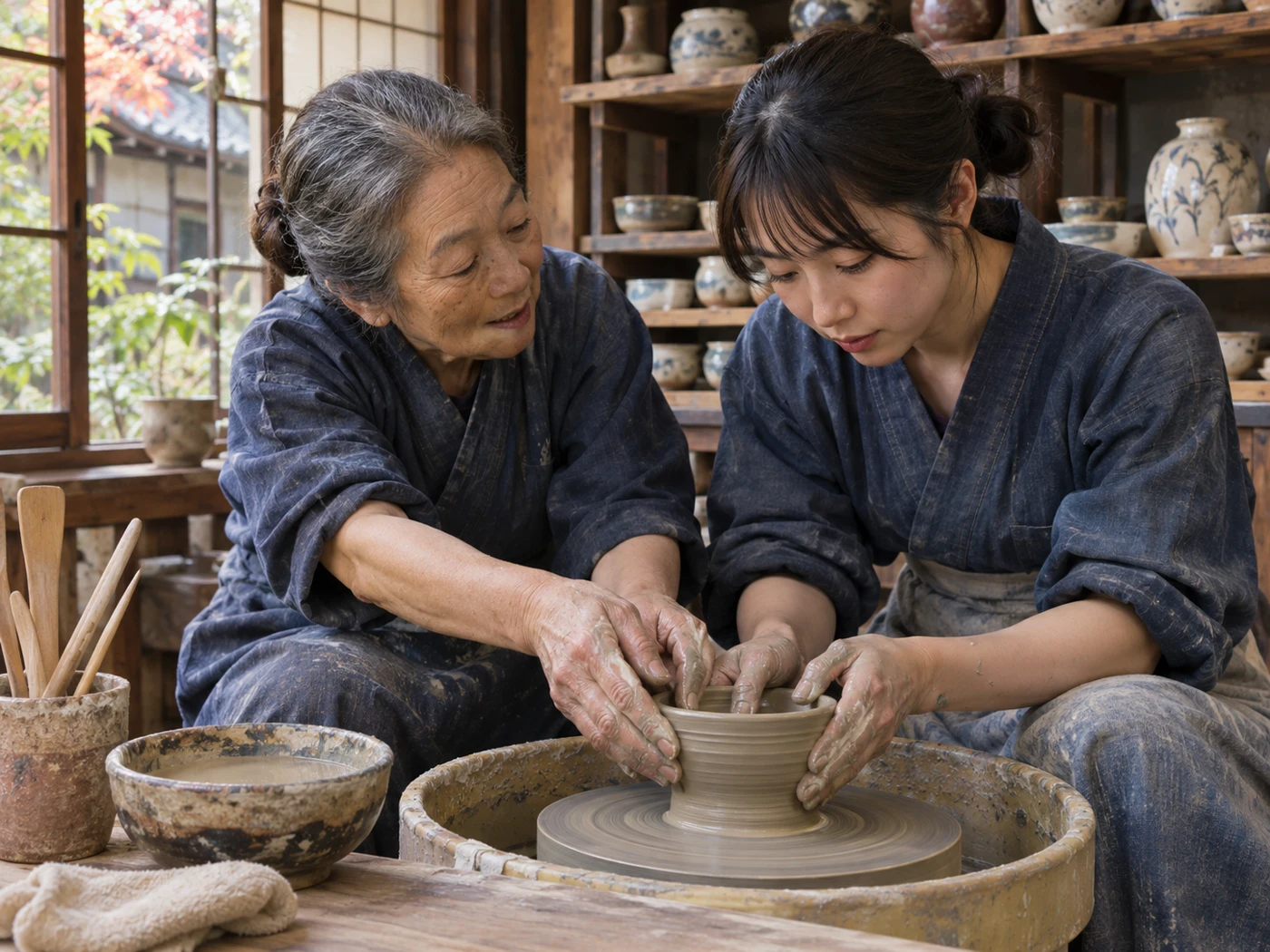
How can cultures shape AI's data, models, values, uses and networks?
Abdel Noubli's response
Culture is not reducible to what is produced. It takes shape in what people receive, transform and pass on.
Preserving a form and passing on knowledge
A model can help restore a trace or widen access to creation. The text examines the limits of this help when the passage between generations requires presence, practice and relationship.
Looking at who shapes the models
Corpora and evaluation criteria reflect choices. The author calls for making these choices visible and involving the communities whose languages and practices are represented.
Assessing the effect on people
The contribution proposes asking whether the tool leaves people the possibility of taking care of a practice, and whether it extends a human encounter. It also invites culture's stakeholders to take part in the places where AI's rules and standards are defined.
Culture Shaping AI — Second Question
PREAMBLE
Before answering, I want to look at two words, because I believe the question is already contained in them.
Artificial comes from the Latin artificialis, from ars — art, skill, craft — and facere — to make. Artificial intelligence means, literally, intelligence made by art. The word has contained art from the beginning.
Culture comes from colere: to cultivate, to tend, to take care of, to inhabit a place over time. The same root gave us cult and colony. Culture, etymologically, is not what we produce. It is what we take care of, across time.
Placed side by side, the two words produce the question I will try to answer:
AI can produce infinitely. Can it take care?
I Where AI intervenes: culture is a loop, and the loop is what breaks
Key Question 1 asks where AI enters the processes through which culture is formed, transmitted and transformed. From my domain, the answer is precise: AI enters the production, and it bypasses the loop.
Culture has never been a one-way output. Someone makes, someone receives, someone is changed, someone transmits differently. The work is not finished when the maker finishes it; it is finished in the person who receives it, and it is transformed again when they pass it on.
I know this from my own experience, before I built technology. I used to write and perform music. What I wrote was not complete on the page. It was completed in a room, by a silence, a reaction, a face. What was missing was never production. It was interaction.
Generative AI produces without a loop. It generates towards no one. This is the same observation I made for networking in the First Question — that the genuinely new is produced in real encounter and cannot exist in any training corpus — and I now think it applies to culture as a whole, not only to professional relations.
There is a second rupture, and I think it is the deeper one. Photography was accused, in 1839, of killing painting; it freed painting instead. But photography still pointed at something that existed: a place, a moment, a body in front of the lens. Generative AI points at nothing. It produces a face that never had a body, a voice that never had a throat. It is the first cultural technology with no referent. That is what is new — not the speed, not the volume.
II What AI augments, what it replaces
The Working Group asks us to qualify the impact as replacement, complement, augmentation or transformation. My answer differs by layer.
Production: augmentation, clearly. What took a studio, a team and months now takes an afternoon and one person. Music, illustration, film, animation, writing — the cost of making has fallen dramatically, and that is genuinely emancipating. I do not want this contribution to be only cautionary: for someone with no studio, no budget and no network, AI removes a barrier that used to be decisive.
Conservation: augmentation, and remarkable. AI can record, restore, translate and archive what was previously untransmissible — as several members of this group have shown for scent, sound and embodied craft. As a conservator, AI is extraordinary.
Transmission: substitution, and this is the risk. Transmission is not the movement of a file. It is a relation between generations, in which the receiver is transformed and transforms in turn. AI can carry the form perfectly and still transmit nothing. To use Tobias's distinction, which I reached independently from my own domain: AI is a carrier, not a bearer.
Creation: an open question, and I would put it carefully. I would not say AI has no intention at all. It attempts one: it tries to anticipate what should come next, to infer what is wanted, to project a continuation. But it does so from rules extracted from the past, and it is missing variables — the present situation, the body in the room, the thing that has not yet been said. It anticipates without knowing what is happening. It advises, accompanies and recombines impressively, but recombining is not wanting. It is not trained on reflection, and it is not trained on the future. It has no consciousness. We are not in the age of superintelligence, whatever is currently announced — which means, and this is the practical consequence, we still have time to decide.
III When the surface becomes free, value migrates
Key Question 2 asks who creates cultural meaning, value and authenticity, and whether value will shift from expression itself towards provenance, participation, community and trust. My answer is yes, and I would put it in economic terms, because that is my profession.
Every era of the internet monetised something — attention, data, convenience — by borrowing trust without ever paying for it. That system held for one reason only: producing a credible appearance was expensive. It required time, skill and resources. Appearance therefore functioned as proof.
AI has driven that cost to zero. The moment the surface becomes free and infinite, the surface stops being proof. Value has no choice but to move to what remains scarce: who made it, through what history, within which community, with what continuity. That is provenance.
And here the etymology returns. Colere — to take care — requires three things: time, continuity, and someone who can lose. A gardener takes care because the garden can die. A craftsman takes care because reputation can be destroyed. A community takes care because it can disappear.
AI risks nothing. It loses nothing. It waits for nothing. Can one take care of what one cannot lose? I do not think so — and I think this, rather than any capability threshold, is the line between producing culture and carrying it.
Japan has already run this experiment, fifteen years before large language models. A synthetic voice released in 2007 became the centre of a genuine culture — tens of thousands of songs, concerts, an iconography, a community. What produced the culture was not the synthetic voice. It was the community that took care of it. The tool was the occasion; the people were the culture.
IV Who are the agents: the hunter, the lion, and the corpus
Key Question 3 asks who creates, defines and transmits culture in the age of AI. There is a proverb I find more accurate than many analyses: until the lion has his own historian, the tale of the hunt will always glorify the hunter.
I speak here as a practitioner rather than an observer. I trained a small language model this year. French and English corpus, Western references, well-known sources. What I put in, it knows. What I did not put in does not exist for it — not as an omission it can report, but as a world it cannot conceive. This is not a technical flaw; it is a mechanical consequence. A model knows only the world of those who held the pen.
Therefore there is no universal model. Not technically, because corpora are situated. And not legally either: Europe regulates, some states ban certain models, others mandate them. “Universal” is, in practice, a polite name for the dominant culture.
So my answer to Key Question 3 is uncomfortable: today, the agents of culture are those who assemble the corpora — and they are very few, very concentrated, and largely invisible to the communities whose culture they encode.
V Each culture will accept AI where it already places trust
Speaking now from the cross-cultural perspective — France, the United Arab Emirates, the United States, Japan, Taiwan, North Africa — I would add an observation from twenty years of doing business in these places.
The forms of trust differ enormously. But so does its position in the sequence. In Japan, trust comes before the transaction: the relationship is built slowly, through repeated meetings, and only then does business follow. In France, trust is carried largely by the institution — the contract, the regulation, the written frame. In North Africa, trust is proven within the negotiation itself; the question is direct and immediate. In the Gulf and the United States, execution comes first and trust follows the result.
This matters for our question, because each culture will accept AI at the point where it already places trust. A society that places trust in institutions will want certification and regulation. A society that places trust in relationships will want to know who vouches for the system. A society that places trust in results will adopt first and ask later. There will be no single global adoption curve, and no single governance model will fit.
This is why I distrust the word “universal” applied to AI. A technology is never accepted for what it does, but for what it confirms. It enters where a society had already placed its trust — and it stalls everywhere else.
VI The paradox of gained time
Several leading figures in the field are now asking for time — to pace the frontier, to let safety catch up. I agree with the request. But I want to raise an objection that comes from history rather than from technology, because it bears directly on our question.
Every time humanity has gained time, it has used that time to produce more. Mechanisation freed the textile worker — and we made more textile. Machines freed agricultural labour — and we produced more food, faster, at greater scale. The internet replaced the encyclopaedia and gave us instant research — and we did not read more deeply; we consumed more.
So when we ask for time in order to build more carefully, the historical record offers an uncomfortable answer: gained time has almost never been converted into care. It has been converted into acceleration.
And time itself resists us. It is abstract, and our experience of it is unreliable. Wait one minute doing nothing and it feels endless; work for the same minute and it vanishes. Most people feel that the last few years have passed faster than any before — and that feeling is not measured by any clock.
This matters for culture more than for safety, because colere — taking care — is precisely the activity that cannot be accelerated. A tradition, a craft, a relationship, a reputation: these require duration, and duration cannot be optimised.
Pacing the frontier is right. But time gained is not time taken care of. The question is not only how much time we buy — it is whether we are still capable of using time for anything other than producing more.
That, I would argue, is a cultural question before it is a technical one. And it is one this group is better placed to answer than any standards body.
VII Five concrete proposals
The Second Question asks how culture should shape AI's data, models, values, use and networks. I propose one answer for each.
Data — provenance at corpus level. We label ingredients in food and origin in wine. We should be able to know, at minimum, which linguistic and cultural bodies a model was built on, and which were absent. Not to constrain training, but so that a community can know whether it is represented or merely described.
Models — plurality by design. I do not believe one intelligence can carry the trust of eight billion people. I believe in the opposite: small, situated, sovereign models — in the limit, one intelligence per person, learning only from its holder. Not an intelligence for humanity; an intelligence for a human. Plurality is not fragmentation: it is how cultures have always survived.
Values — the care test. Before deploying a cultural AI system, ask: does it allow someone to take care, or only to produce? Does it leave room for time, continuity and responsibility — or does it remove them?
Use — the loop test. I proposed this in the First Question and I maintain it: does the tool end in a human encounter, or does it end in itself? A system that increases real human exchange carries culture. A system that replaces the exchange substitutes for it.
Networks — be in the room now. This is the most urgent and the least discussed. In September 2026 alone, the IETF opened a working-group draft on AI agent identity, NIST finalised guidance on protecting identity tokens, and the major payment networks began building a “Know-Your-
Agent” interoperability framework. A trust architecture for autonomous agents is being written this year — separating identity, delegated authority and provenance into distinct verifiable layers.
These are the rooms where the rules of the next decade are being fixed. They contain engineers, regulators and payment networks. They contain almost no one whose profession is culture. If culture is to shape AI rather than merely comment on it afterwards, it has to be present where these specifications are drafted — now, while they are still drafts.
VIII Closing — what crosses the ages
AI is not an eighth art to be added to the list. It does not stand beside painting, music or cinema. It operates on all of them at once — recombining, imitating, replaying. It has no rank because it does not line up with the others; it sits above them. Which is precisely why the question of who governs it is cultural, not only technical.
The Greeks did not separate art from technique. Technē named both the sculptor and the carpenter. The division between fine art and craft is modern — eighteenth century. So asking whether AI is an art is a modern question. In Greek terms, AI is a technē, and technē has always been culture. Writing code is no less cultural than carving stone.
One thing this group should not lose sight of: culture protects human identity. It is not an ornament of civilisation, nor an economic sector. It is what allows a person to know where they come from, what they belong to, and what they will pass on. A community that loses its culture does not lose a heritage: it loses the ability to recognise itself.
And this crosses the ages in a way no technology can claim. More than thirty thousand years ago, in a cave, someone placed a hand against a wall and blew pigment around it. We still receive that gesture. Neither the language, nor the name, nor the intention of that person reached us — but the transmission worked. Thirty thousand years later, someone looks and understands that another human being was there.
By comparison, generative AI has three years of public use. We do not yet know whether it will endure in this form, whether it will transform, or whether it will join the long list of techniques that dazzled their age before being absorbed. It seems healthy to keep that proportion in mind: the newest technology should not dictate its rules to the oldest human practice.
Let us also note that the question is not hypothetical: culture is already shaping AI, and AI is already inside every art. Music and songs are being generated, images and paintings, films, and — through 3D printing — even objects and sculpture. The loop is already turning. The question is not whether it will happen, but whether the people whose profession is culture will have any say in how it turns.
Let us imagine the year 2100 for a moment. Identity will likely be biometric, perhaps neural. Robots will share our spaces. Biotechnology will have blurred the line between what is born and what is
manufactured. Our digital twins will have outlived us and will still speak in our name. In that world, almost everything we call “technology” today will have changed form.
One thing alone will have crossed: the gesture of transmitting. It will be thirty thousand years old, plus a few decades.
So I leave this group with the question I ask myself:
In a world where everything can be generated, verified, augmented and extended — what will we have chosen to keep doing ourselves?
We still have time to answer. AI has no consciousness, no experience of loss, and no access to the present. It works from the past. That is not a weakness to mock — it is the window in which we can still decide what we want it to carry, and what must remain ours to tend.
AI can produce infinitely. Only we can take care.
Submitted to the AI × Culture Working Group · Kyoto Culture Forum · 18 September 2026